


Let me guess…your business is looking to use AI. You’ve heard about all the possibilities of what AI can do in business, such as automating tasks and even increasing revenue. Of course it’s enticing, and of course…you don’t really know how to get started. But don’t worry, you’re certainly not the only person saying, “How do I begin?”
The important thing to remember when making decisions about AI and data platforms is that you’re not choosing for today’s use cases. It’s best to think of it as which platform will reduce the friction between idea and production. A platform that's 80% as capable as you’d like but gets you to market faster wins in practice.
This article will break down a decision framework to help you understand where your organization currently is and needs to go, the big 3 different data platforms with strengths and weaknesses, and key pricing considerations that will help you make strategic decisions to position your organization for AI success this year and beyond.
Quick Recap: Different Types of AI
If synergy was the corporate buzzword of the 80s and 90s, AI is the buzzword of the 2020s. The problem is, AI covers a huge range of technologies. For us to compare different data platforms, we need to be specific about the different types of AI. They all have different infrastructure requirements, and the platforms do not serve them all equally.
Classic ML/Predictive Analytics: forecasting, scoring, classification, churn prediction, fraud detection, and demand forecasting
This still drives the majority of measurable AI ROI, despite being overshadowed by the generative AI (GenAI) hype
Deep Learning: neural networks for images, unstructured text, complex time-series, document processing, quality inspection, anomaly detection
Increasingly commoditized, specialist work in 2022 is now often a managed API call
Generative AI (GenAI)/LLMs: models that generate text, summaries, code, synthetic data; includes RAG (Retrieval-Augmented Generation), which connects LLMs to enterprise data. Internal copilots, automated reporting, AI assistants, contract analysis.
Fastest-moving category, RAG and vector search went from experimental to table-stakes between 2023 and 2025
Agentic AI: The current craze in the AI world; AI that takes sequences of actions autonomously, queries data, completes multi-step tasks with minimal human intervention, automates analysis workflows, AI-driven operations.
Most enterprises are 12–24 months from production scale, but platform decisions made now determine whether they can participate
Fuzzy Logic / Rules-Based Systems: explicit business rules and decision tables, predating the current AI wave; still dominant in regulated industries (insurance, finance, healthcare)
Platforms need to coexist with these systems, augmenting them when possible.
The Decision Framework
If choosing an AI data platform for business were easy, we wouldn’t need to write this article. The “best” platform in a vacuum is rarely the best platform for your specific needs and organization. You’re likely going to have existing constraints that will very much impact your decision.
Before you even begin evaluating platforms based on features and costs, you need to ask yourself these 5 questions:
Where does your data already live?
Who are you already paying for cloud services?
What in-house expertise do you have (and can realistically hire for)?
How do your teams need to interact with AI (SQL, notebooks, no-code, API)?
What compliance/sovereignty requirements apply to your data?
These questions will help you understand where you’re currently at, and what is going to be realistic in terms of platform expectations. Let’s say your organization runs on Azure, your data lives in OneLake, and you’ve identified large-scale batch LLM classification as a use case. You might be tempted to select AWS Bedrock Batch Inference for a platform because of the strong batch processing infrastructure, but it’s likely not worth it because you’re already in a Microsoft environment. Azure OpenAI Batch is likely sufficient because it’s 50% cheaper than real-time inference, there’s no cross-cloud data pipeline, and there’s no new vendor relationship or billing to manage.
Now, AWS Bedrock batch could be worth the overhead if, say, the volume is large enough that per-token cost differences materially change the business case. But it all depends on a variety of factors, such as if your team even has AWS expertise or timeline.
TL;DR The real question is never "which platform has the best feature(s) and price? It's "what is the total cost of the solution, including engineering, data movement, ongoing maintenance, and team expertise?" Try to run a total cost of solution analysis on any cross-platform architecture before assuming the savings are real.
Platform Overview: Strengths & Limitations
Now that you have a strong understanding of your constraints, it’s a great time to compare some of the key platforms available: AWS, Microsoft, and Snowflake. There are plenty more options out there, but these are considered the big 3.
AWS: SageMaker, Bedrock, and Amazon Q
It’s important to note that AWS AI tools don’t form a single, coherent platform. They’re 3 distinct services that represent AWS’s enterprise AI offerings, and the integration between them requires deliberate engineering.
SageMaker: End-to-end ML platform covering the full lifecycle from data prep to model deployment.
Core Strengths: Most comprehensive ML toolset available (Feature Store, Model Registry, Pipelines, Experiments, Ground Truth (data labeling), Clarify (bias/explainability), Canvas (no-code ML))
- SageMaker Studio provides a unified IDE for the full ML workflow
- Strong MLOps story: model versioning, A/B testing, monitoring, drift detection all built in
- Best platform for organizations building and maintaining custom models at scale
- Massive compute flexibility: GPU instances, Inferentia/Trainium chips for cost-optimized inference
Best Fit: Organizations with mature data science teams building proprietary models. Heavy ML research environments.
Amazon Bedrock: Managed generative AI service providing access to foundation models via API, with enterprise tooling on top.
Core Strengths:
- Widest foundation model selection of any platform (Anthropic Claude, Meta Llama, Amazon Titan, Mistral, Cohere, Stability AI (images), and others)
- No data sharing (models are not trained on your input)
- Bedrock Agents: build agentic workflows that call APIs, query knowledge bases, take multi-step actions with no servers to configure
- Knowledge Bases: managed RAG infrastructure: ingest documents, auto-embed, store in vector DB, retrieve at query time
- Guardrails: content filtering, PII redaction, topic restrictions applied consistently across models
- Batch inference: 50% cost reduction for asynchronous large-scale workloads
- Model flexibility means organizations can choose the right model for the right task
Best fit: Organizations that need model flexibility, are running high-volume inference workloads, or need agentic AI capabilities with strong guardrails. AWS-native organizations.
Amazon Q: AWS's applied AI assistant product that sits on top of AWS services and enterprise data sources. It has sub-products, including Q Business, Q Developer, and Q in QuickSight.
Core Strengths:
- Q Business is a strong answer to the "enterprise ChatGPT on our data" use case without building RAG from scratch
- Permission-aware by default — answers are filtered based on the user's existing access rights
- Broad connector library reduces integration effort
Limitations:
- Q is less well-known than Copilot (Microsoft) in the market — perception gap vs. actual capability
- Three separate Q products with different pricing and setup adds to the AWS complexity tax
- Q Business requires AWS infrastructure investment to deploy and maintain
Best fit: A very specific organization with very specific needs
Microsoft Fabric
This is Microsoft's unified analytics platform that launched 2023, consolidating Power BI, Azure Data Factory, Azure Synapse, and other services into a single SaaS product built on OneLake.
Core Strengths:
- OneLake: single logical data lake across the organization, no data duplication between services. All Fabric workloads read from the same storage layer.
- Unified governance: Microsoft Purview integration means one governance, compliance, and lineage layer across all data, not tool-by-tool.
- Copilot everywhere: AI assistance is embedded across Power BI, notebooks, pipelines, and data engineering.
-Direct Lake mode: Power BI queries OneLake directly without importing data, removing a major bottleneck in traditional BI architectures.
-Microsoft ecosystem depth: native integration with Teams, Office 365, Azure OpenAI, Dynamics. For organizations already in Microsoft, the connective tissue is already there.
-Fabric Data Agent: agentic AI layer that can reason over organizational data, answer complex multi-step questions, take actions. Early but maturing fast.
-Real-time intelligence: event streaming and real-time analytics built into the platform.
AI-specific strengths:
- Azure OpenAI is the native LLM provider: most of their models are available without leaving the platform
- Copilot in notebooks accelerates data science and engineering workflows
- Vector search and semantic search capabilities built into OneLake ecosystem
- AI Builder (Power Platform) for low-code ML (accessible to non-technical users)
Limitations:
- Model choice is limited: you get Azure OpenAI, not the full open model ecosystem
- Still maturing: some features released under Fabric branding were repackaged from Synapse/ADF and carry legacy complexity
- Vendor lock-in is high: OneLake is proprietary; migrating out is a significant undertaking
- Pricing model is still settling; capacity units (F-SKUs) can be difficult to predict at scale
- Many of their offerings are designed to meet the needs of 1% use cases and this adds significant complexity
- Copilot is a work in progress
Best Fit:
Organizations already all-in on Azure
Enterprises wanting a single governed platform over best-of-breed assembly
Strong BI and reporting needs alongside ML/AI
Organizations that want AI to be accessible to both technical and non-technical users
Snowflake
Snowflake is a cloud-native data platform, originally a data warehouse, evolved into the "Data Cloud." Runs on AWS, Azure, and GCP. Neutral by design.
Core strengths:
-Cloud neutrality: genuinely multi-cloud, allowing organizations to run Snowflake on whichever cloud their data is closest to, or span multiple clouds.
- Data sharing and Marketplace: industry-leading capability to share live data across organizations without copying. Snowflake Marketplace has thousands of third-party datasets. Strong differentiator for data product use cases.
- Cortex AI: LLM functions directly in SQL. `COMPLETE()`, `EXTRACT_ANSWER()`, `CLASSIFY_TEXT()`, `TRANSLATE(), run LLM tasks without leaving the data layer. Major ergonomic advantage for SQL-native teams.
-Cortex Search: vector search built into Snowflake, enabling RAG directly on Snowflake data.
-Cortex Analyst: natural language to SQL, allowing business users to query data conversationally.
- Snowpark: run Python, Java, Scala within Snowflake compute. Brings data science workflows to where the data lives.
-Arctic: Snowflake's own open-source LLM, optimized for enterprise SQL and structured data tasks. Cost-efficient for specific use cases.
-Document AI: extract structured data from documents natively.
-Streamlit integration: build and deploy data apps directly within Snowflake.
AI-specific strengths:
- Cortex LLM functions mean teams can do LLM classification, extraction, and summarization in SQL without a separate infrastructure layer
- Strong RAG story with Cortex Search: vector embeddings stored and searched natively
- Model choice is improving: Cortex supports multiple underlying models including Llama, Mistral, and Snowflake Arctic
Limitations:
- Not a full analytics platform on its own: most organizations still need a BI tool on top (Tableau, Power BI)
- Compute costs can escalate quickly on large, poorly optimized workloads
- AI/ML depth is shallower than SageMaker: not the right platform for custom model training at scale
- In practice most serious Snowflake deployments pair it with S3 or ADLS for raw/cold storage and use Snowflake only for the processed, query-ready layer. This is effective but means Snowflake is rarely the *only* platform in the stack.
Best Fit:
Organizations that are genuinely multi-cloud, want cloud portability, or their data lives in on one of the big-3 hyperscalers and they need the processing power
Data-product-focused organizations sharing data across business units or with external partners
SQL-native data teams that want AI capabilities without switching tools
Organizations that want to avoid deep dependency on a single hyperscaler
Greenfield Scenario
If your organization is in “greenfield” situation, it’s sort of a double edge sword. You have the maximum options…but also the hardest decision because you have no constraints to help filter choices. If you’re starting from nothing, ask yourself these questions to help narrow the field:
Is your primary need BI and reporting, or ML and model development, or GenAI/LLM workloads?
Do you want one vendor to own or do you want best-of-breed flexibility?
How technical is your data team: SQL-native, Python-native, or low-code?
Do you anticipate needing to share data across organizational boundaries?
What's your budget model preference: predictable subscription or consumption-based?
Greenfield organizations have no existing cloud commitments, no legacy data infrastructure, and nothing already anchoring you to a vendor. This creates the problem of “too many options”.
The general greenfield take in 2026:
Microsoft Fabric is the strongest single-platform choice for most mid-to-large enterprises starting fresh, *if* they are willing to commit to the Microsoft ecosystem.
Snowflake is the strongest choice for organizations prioritizing cloud neutrality, massive scale, and data sharing.
AWS wins for organizations with strong engineering teams who want maximum depth and model flexibility.
Pricing Comparison
A platform that's 20% cheaper but unpredictable in billing is often worse than a slightly more expensive platform with a fixed monthly spend. Each of these 3 platforms uses a fundamentally different model. The cheapest platform on a per-feature comparison is rarely the cheapest platform in production. Total cost of ownership requires accounting for:
Storage at your actual data volume
Compute at your actual workload patterns
Engineering time to manage and optimize costs
BI and complementary tools required to fill gaps (especially relevant for Snowflake)
Egress when data crosses cloud boundaries
AWS Pricing
AWS has no platform-level subscription, you pay for what you use across each service independently. This is best for organizations with strong FinOps capability or AWS expertise who want maximum cost control levers. High-volume AI workloads where per-token and per-instance optimization materially changes the economics. However, AWS has the most sophisticated cost optimization tooling of any platform (Savings Plans, Spot Instances, Graviton processors, Inferentia chips)
SageMaker: Instance-based pricing for training jobs and hosted endpoints — pay per hour of compute
Bedrock: Per-token pricing — varies significantly by model
Amazon Q: Business and Developer Pro paid tiers, along with free tiers for both with limited features
S3 Storage: Standard and Intelligent Tiering available, with additional costs for data egress when data leaves AWS (often something catching cross-cloud architectures off guard)
Watch points: AWS bills across dozens of services simultaneously total cost visibility requires either AWS Cost Explorer discipline or a third-party FinOps tool
Egress costs are the most common source of billing surprises, especially for organizations with data in multiple clouds
Bedrock token costs at scale (millions of documents, high-frequency inference) can exceed SaaS alternatives if not optimized
Microsoft Pricing
You buy compute capacity units (F-SKUs: F2, F4, F8... up to F1024) rather than paying per query or per job. This is best for organizations that want a predictable monthly bill and are comfortable committing to a capacity tier.
-Capacity can be paused when not in use: important cost control lever, especially for dev/test environments
-OneLake storage billed separately at ADLS Gen2 rates (~$0.023/GB/month)
-Power BI Premium is included in Fabric capacity: organizations already paying for Power BI Premium Per Capacity are partially funding Fabric already
-Microsoft 365 E5 customers may have existing Fabric entitlements worth auditing before purchasing new capacity
Watch Points: Right-sizing F-SKUs is non-trivial. Buy too little and workloads queue; buy too much and you overpay
Pricing model is still relatively new and has changed since launch; worth checking current Microsoft documentation before quoting numbers
Autoscale option exists but adds complexity
Some advanced AI features (Azure OpenAI via Fabric) may incur additional token-based charges on top of capacity
Snowflake Pricing
Snowflake utilizes credit-based consumption for its pricing. This is best for organizations that want flexibility and can invest in warehouse management discipline. Data teams that are already Snowflake-native and know how to optimize spend.
-Compute is billed in Snowflake Credits: different virtual warehouse sizes consume credits at different rates (XS through 6XL)
-Credits can be pre-purchased (cheaper) or consumed on-demand (more expensive)
-Storage billed separately: ~$23–40/TB/month for managed storage
-Auto-suspend warehouses stop consuming credits when idle: critical to configure properly or costs run unexpectedly
-Editions matter: Standard, Enterprise, Business Critical: many features (multi-cluster warehouses, data masking, time travel beyond 1 day) require Enterprise or above
Watch Points: Cortex AI (LLM) functions consume credits. LLM workloads at scale can burn credits faster than expected
Organizations frequently underestimate Snowflake costs in the first year before they learn to right-size and auto-suspend
Total stack cost is often higher than it appears because most deployments also require external object storage (S3/ADLS) plus a BI tool
Enterprise edition pricing is significantly higher than Standard. Many organizations discover they need Enterprise features after signing Standard contracts
Keyrus Ai: Architect of intelligence
At Keyrus, we help organizations move from experimental AI to industrialized AI, from isolated agents to orchestrated systems, and from insight to execution. This is the discipline we call being an Architect of Intelligence. Designing the Operating System of the intelligent enterprise, where intelligence is embedded into the core of business processes to create sustainable value: we operationalize intelligence.
Powered by our proprietary Human Orchestrated Model™ (HOM), we architect reliable:
-Intelligence Foundations,
-Human in Command governance,
-and Performance Steering,
To create intelligent environments where technology amplifies human capabilities and performance compounds over time. With 30+ years of expertise and 2,800 people across 28 countries, we help organizations go beyond transformation: to build adaptive, resilient, and continuously improving intelligent organizations.
As a certified AWS, Microsoft, and Snowflake partner, no one is more qualified to establish your AI data platform than Keyrus. Learn more about our partnerships and how we architect intelligence here.
Retrieval Augmented Generation. It connects a language model to a live search over your own content, so answers are grounded in current, organization-specific information rather than the model's general training. It's how you keep an AI from making things up about your business.
In work that's high-volume, rules-heavy, and spread across more than one system — the multi-step processes that quietly eat your team's hours without really needing their judgment. The more repeatable and structured the process, the bigger the payoff. For most organizations the technology is ready enough now that the real question is where to start, not whether.
An open standard that gives AI applications one consistent way to connect to external tools and data, instead of building custom integrations for every pairing. Now an open-source project under the Linux Foundation, it's often described as a "USB-C port for AI." It's what makes agents practical to connect to many systems at scale.
An AI agent is a single system built to do one well-defined task within set boundaries. Agentic AI is the broader system that coordinates multiple agents, tools, and data sources to pursue a goal across several steps and systems. An agent executes a task; an agentic system owns an outcome.
Snowflake provides access to a variety of high-performance models from providers including Google (Gemini), Meta (Llama), Mistral AI, Anthropic (Claude), and OpenAI (GPT-4). This allows users to choose the right model size and performance level for their specific use case.
Cortex AI operates on a credit-based, consumption-only pricing model. Costs are determined by the specific model used (e.g., GPT-4 vs. Mistral 7B) and the volume of tokens processed. There are no upfront costs or separate infrastructure management fees.
Snowflake Cortex AI is a fully managed service that provides low-latency access to industry-leading large language models (LLMs) and search capabilities directly within the Snowflake Data Cloud. It allows users to perform AI tasks like summarization, translation, and data extraction using standard SQL or Python without moving data outside the security perimeter.
Teams should evaluate four key factors before choosing an AI framework: whether it integrates with their internal data and tools, how it handles security and data access, whether the vendor trains on your data, and whether their team has the technical skills to build and maintain the solution. 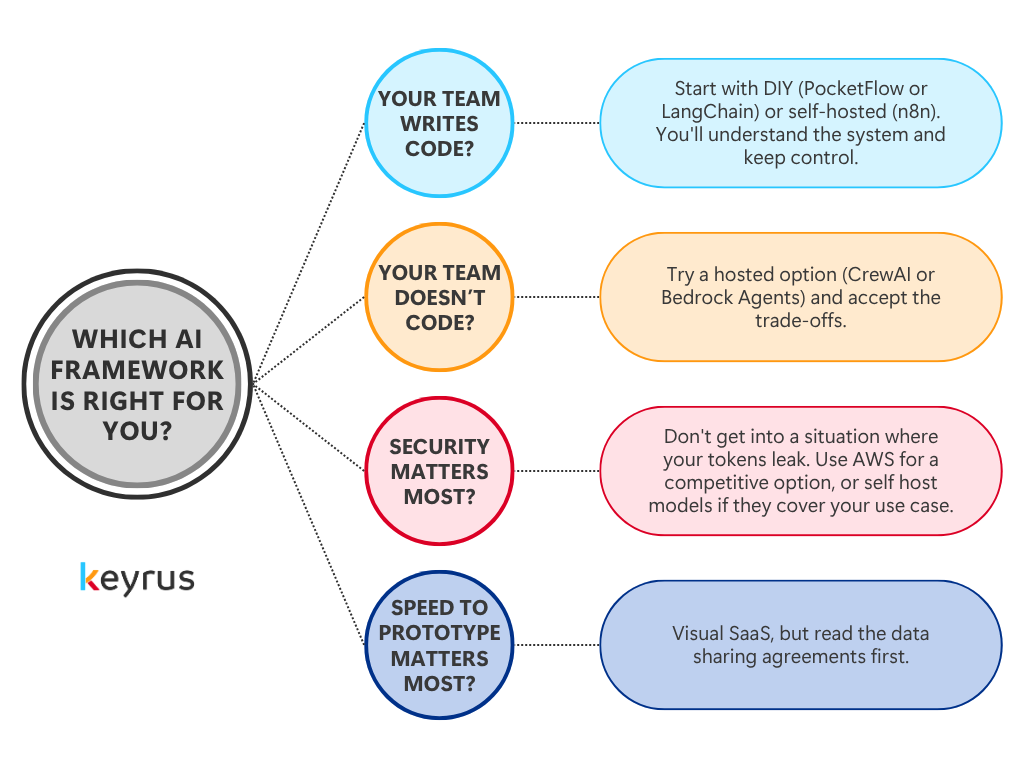
LangChain is a developer-focused DIY framework offering maximum control and deep integration with tools like LangSmith, but requires strong programming skills. CrewAI is a visual, low-code platform that is faster to set up but is newer, less battle-tested at scale, and carries data privacy trade-offs.
AWS Bedrock and self-hosted options like n8n offer the strongest data privacy guarantees. Unlike most SaaS tools, AWS Bedrock does not train on your data by default, and self-hosted frameworks keep your data entirely within your own infrastructure. 
Visual SaaS tools like CrewAI or AWS Bedrock Agents are the best starting point for non-technical teams. They offer no-code or low-code interfaces and fast setup, though teams should review data sharing agreements before committing.
At Keyrus, our perspective is shaped by years of working at the intersection of data strategy and organizational change. We believe AI literacy initiatives are most effective when they: 1. Start with demystification, not technical depth. The goal is confidence and curiosity, not expertise. 2. Connect to real business context. Abstract concepts land when they're illustrated with examples relevant to participants' actual work. 3. Include hands-on engagement. Understanding how a machine learning model learns is more durable when people have trained one, even a simple one. 4. Address ethics and governance alongside capability. These aren't separate topics; they're part of the same conversation. 5. Are tailored by persona. Each level of your organization will have different needs than the others.
LLM (Large Language Models) AI models trained on vast quantities of text that can understand and generate human language. The technology behind tools like ChatGPT, Claude, and Microsoft Copilot.
ML (Machine Learning) A subset of AI where systems learn from data rather than being explicitly programmed. ML models improve with exposure; they find patterns and make predictions without being told the rules.
At its core, a machine learning model is a mathematical structure that adjusts itself based on data. During training, it's exposed to enormous volumes of examples and iteratively refines its internal parameters to minimize errors. What emerges is not a set of hard-coded rules, but a statistical model of relationships: the AI has learned patterns, not memorized answers.
AI (Artificial Intelligence) The broad field of building machines that can perform tasks requiring human-like intelligence: reasoning, pattern recognition, decision-making, and language understanding.
The term "AI literacy" gets used loosely, so it's worth being precise. AI literacy is the ability to understand, evaluate, and work with artificial intelligence in a way that is effective, purposeful, informed, and responsible. It has three interconnected dimensions: - #1- Conceptual understanding: Knowing what AI is, how it works at a meaningful (if not technical) level, what distinguishes different types of AI systems and how to select the right type of AI tools that would add value to the organization. - #2- Applied capability: Being able to identify where AI can add value in your work, how to interact with AI tools effectively, how to utilize it in a way that brings measurable results, and how to evaluate the outputs you receive. - #3- Ethical and governance awareness: Understanding the risks AI introduces, the biases it can carry, and the responsible practices that should govern its use.
through natural language prompts. Q2: What is the difference between Cortex AI and Cortex Code? Cortex AI applies AI and machine learning directly to your data through SQL functions (such as sentiment analysis or classification). Cortex Code is a development agent that helps you build data infrastructure — generating dbt pipelines, Airflow DAGs, and Streamlit apps. Cortex AI powers intelligence within your data; Cortex Code accelerates how you build on Snowflake.
Microsoft Fabric is an all-in-one, AI-powered cloud platform that unifies data engineering, warehousing, data science, real-time analytics, and business intelligence (Power BI) into a single SaaS solution. It streamlines data management by utilizing OneLake, a centralized data lake, to eliminate data silos.
1. Exploding Costs: Inconsistencies in pipelines lead to financial issues. Inefficient code burns through Fabric Capacity Units (CUs) faster than necessary. This is the biggest challenge and “cost” of falling into the Trap. 2. Team Bloat: You find yourself needing a larger team just to handle the bugs, maintenance, and clean up technical debt, rather than delivering new insights. 3. Significant Manual Maintenance: If a new auditing standard or error logging requirement is introduced, you must manually update dozens, or even hundreds, of separate pipelines. 4. Longer Training for New Hires: New hires struggle to onboard because every project follows a different structure, requiring weeks of training just to understand the local "flavor" of engineering.
At Keyrus, we believe the three (3) essential practices of AI Governance are model risk management, data quality & governance, and MLOps and continuous monitoring.
At Keyrus, we believe the three (3) pillars of AI Governance are Process, People, and Technology. These pillars serve as a solid foundation for building your own AI governance policies and rules.
AI Governance is a set of rules, standards, and policies put in place to ensure AI is being used properly, ethically, legally, and responsibly. It often manages risks such as bias and privacy breaches, while enabling innovation. AI governance ensures that AI technologies are developed, used and maintained in a way that maximizes outcomes and trust while keeping risks and security under control. In short, AI governance maximizes the benefits of your AI investments, whilst minimizing risks and potential harms. Accumulating more than 28 years of experience in data and artificial intelligence, Keyrus helps you to set-up the right AI governance to create competitive advantage from AI.
Keyrus is proud to be a Microsoft funding, reselling, and delivery partner and to have worked on numerous Microsoft Fabric projects. We know that data is unquestionably a key to success for businesses. When used intelligently, it opens unique opportunities for facing present and future challenges. At Keyrus, we enable organizations to deploy the capabilities to make data matter: by leveraging data and AI to start making smarter, more impactful decisions.