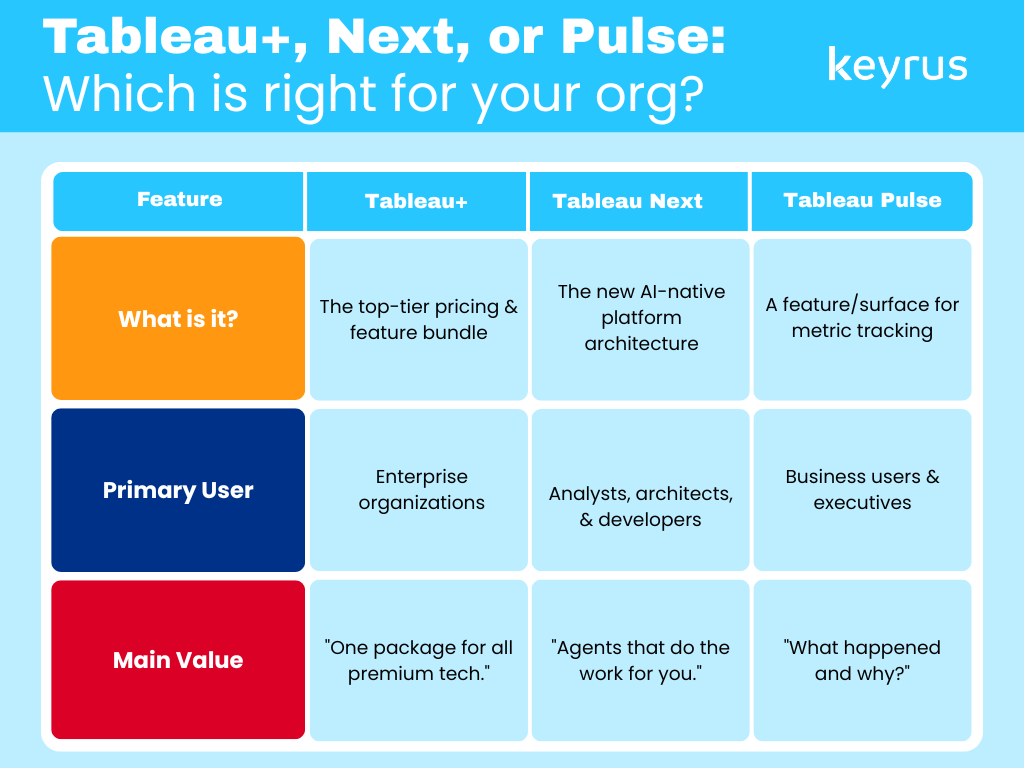
If you've been keeping up with the Tableau ecosystem lately, or if you caught any of the buzz coming out of last year’s Tableau Conference, you've probably noticed that Salesforce and Tableau are making some of the boldest (and, albeit, confusing) moves in their product history. The analytics landscape, like everything in tech right now, is shifting fast, and Tableau is responding with a suite of new and evolving offerings that can honestly feel a little overwhelming at first. Three names in particular keep coming up: Tableau Next, Tableau Pulse, and Tableau+.
TL;DR Tableau+ is the licensing tier that unlocks access to newer AI-powered capabilities; Tableau Pulse is an intelligent metrics and insights experience built for business consumers; and Tableau Next is an entirely new, AI-native analytics environment built on Salesforce's Data Cloud and Agentforce platform.
Each has a specific purpose, and knowing those roles is the difference between a strategic investment and a confusing one. Whether you're a data team lead trying to plan your roadmap, an IT administrator figuring out licensing, or an executive asking, "What exactly are we paying for?", this breakdown is for you.
At a Glance: A Quick Comparison Guide
Before digging into each product, here's a quick look at where they differ across the factors that matter most:
Tableau Pulse | Tableau Next | Tableau+ | |
What it is | AI-driven metrics experience in Tableau Cloud | New AI-native analytics environment in Salesforce | Licensing tier |
Primary user | Business consumers, executives | Data professionals, analysts, developers | All |
Core capability | Automated metric insights & alerts | Unified dashboarding, semantic modeling, metrics, and agents | Unlocks Next and other AI features |
Data foundation | Existing Tableau data sources | Salesforce Data Cloud | Both |
AI interaction | Narrowed Natural Language Questions | AI agents (Data Pro, Concierge, Inspector), Enhanced Pulse Q+A | N/A (licensing) |
Maturity | Generally available | Generally available | Available as of 2025 |
No | Requires Data Cloud setup | No |
The important clarification upfront: Tableau+ is not a competing product to Next or Pulse: it's the licensing vehicle that makes those products accessible. Think of it as the key that opens the door.
What is Tableau Next? The New Frontier of AI-Native Analytics
At its core, Tableau Next unifies what has historically been a fragmented set of tools: traditional dashboarding, semantic modeling, collaboration assets, and agent-driven metrics and insights all live in a single environment. The underlying foundation is Salesforce's Data Cloud and the Agentforce platform, which means Tableau Next is designed from day one to work within the broader Salesforce ecosystem rather than alongside it. It represents a fundamental rethinking of what a modern analytics environment should look like, not just incremental AI features added onto an existing platform, but a ground-up reimagining of how people interact with their data.
One of the most exciting aspects of Tableau Next is its out-of-the-box AI agent lineup. Three agents were highlighted prominently at TC25:
Data Pro assists in creating and refining hygienic and appropriately related semantic models and data sources.
Concierge serves as a natural language guide for any questions you have about your data, responding with Tableau visualizations and AI insights anywhere in Salesforce.
Inspector takes on monitoring and diagnostic tasks, surfacing anomalies and issues before they become problems.
These agents aren't designed to replace analysts; they're designed to extend what analysts can do, and to put more capability in the hands of business users who have never been comfortable with traditional BI tools. Rather than waiting for a dashboard to be built, users can ask questions directly and get answers. The Agentforce integration also means Tableau Next agents and topics can be embedded into custom Salesforce workflows, further expanding where analytics can live.
The critical thing to understand about Tableau Next is that it requires preparation. It's not a toggle you flip on. Because it's built on Data Cloud, your organization needs to have source data properly ingested and configured in Data Cloud before Tableau Next can fully deliver on its promise. This means assessing your existing data architecture, establishing ingestion pipelines (whether batch, streaming, or Zero Copy), and building out Tableau Semantics (aka the new modeling layer that replaces and extends what you've historically done in Tableau's data prep and modeling tools). CRMA users should take stock of existing reports and plan for how that content migrates into the new environment.
Teams should also think carefully about people readiness. Tableau Next and Agentforce specifically create real opportunities to expand the roles of data professionals. The technical expertise needed to build, configure, and refine agents is intricate, and organizations that identify and cultivate internal champions now will be far better positioned when Tableau Next becomes the primary environment for new analytics work.
It's also worth noting what Tableau Conference ‘25 made very clear: Tableau Cloud, Server, and Desktop are not going away. Tableau Next is an addition to the ecosystem, not a replacement for it. Existing content, existing teams, and existing workflows remain supported and continue to evolve with new features.
What is Tableau Pulse? AI-Powered Insights Automatically Delivered
While Tableau Next represents the future of how analysts and developers will build and explore, Tableau Pulse is focused on getting the right insights to the right people without requiring them to become analysts themselves.
Tableau Pulse is an AI-powered metrics experience included in all Tableau Cloud licensing that surfaces intelligent, personalized insights directly to business consumers. Rather than asking users to navigate a dashboard and draw their own conclusions, Pulse monitors the metrics that matter to a person's role and proactively delivers natural-language explanations of what's happening, why, and what to pay attention to.
The experience is conversational and contextual by design. Users can ask follow-up questions about their metrics in natural language, such as "Why did revenue drop last Tuesday?" or "How does this week compare to last quarter?", and get clear, relevant answers without needing to know anything about the underlying data model. For executives, managers, and front-line business users who need data to make decisions but don't have the bandwidth to build or explore dashboards, Pulse removes the barrier entirely.
Pulse is built on top of the data sources already living in your Tableau environment, which means adoption doesn't require a wholesale infrastructure overhaul. The setup investment is largely in defining the right metrics and ensuring the underlying data sources are clean, trusted, and well-governed, which, if your organization has done its migration and data quality work, can be a relatively smooth lift.
Pulse works best in organizations that have already done the hard work of establishing a strong analytics foundation: a well-maintained Tableau Cloud environment, trusted and documented data sources, and clearly defined business metrics. When those elements are in place, Pulse can deliver incredible value almost immediately, extending the reach of data-driven decision making to stakeholders who would never have opened Tableau on their own.
It's also worth calling out what Pulse is not. It's not a replacement for the flexible, deep-dive analysis that experienced analysts do in Tableau. It's not a tool for data modeling or dashboard creation. It's the delivery mechanism that takes insights from your data team's work, and puts them in front of the people who need to act on them.
What is Tableau+? The Licensing Tier That Brings It All Together
Tableau+ was announced in 2025, and it's worth spending a moment on it because it usually to cause the most confusion (especially because when spoken, “Pulse” and “Plus sound similar). Unlike Tableau Next and Tableau Pulse, Tableau+ is not a product in its own right; it's a licensing tier that determines what features and capabilities your organization has access to within Tableau Cloud.
Think of it like moving from a standard to a premium subscription tier. Standard Tableau Cloud licensing gives you access to Pulse, and Tableau+ includes access to Tableau Next and its AI agents, a Data Cloud environment for use with Tableau Next, and an Enhanced Q+A functionality with Pulse. It's the entry point for organizations that want to take advantage of Salesforce's full AI-powered analytics roadmap, rather than just the core dashboarding and visualization capabilities.
From an administrative and planning standpoint, Tableau+ simplifies a conversation that used to require piecing together multiple add-ons. If your organization wants AI agents, automated metrics intelligence, and a path toward Tableau Next adoption, Tableau+ is the licensing model to pursue.
It's also where the broader Tableau ecosystem story comes together. The cloud migration investments that organizations have made, such as moving off Tableau Server, setting up proper authentication, establishing Cloud Manager, and building their project structure, all pay off more fully under Tableau+, because those foundations are what Pulse and Next are built on top of. The organizations that migrated thoughtfully, with clean governance and well-structured environments, are the ones who will get the most out of Tableau+ from day one.
Important note: Tableau+ is what gives access to AI capabilities that are exclusive to Tableau Cloud. This is one more compelling reason why organizations still on Tableau Server should be actively planning their migration. The gap between what's available on Server versus what's becoming available on Cloud, especially at the Tableau+ tier, will only grow wider over time.
Choosing the Right Tool for Your Business
So where does your organization fit in? The right approach here isn't really a binary choice between these three; it's about understanding your current state and developing a realistic path forward.
If your data team is asking, "How do we scale analytics without scaling headcount?" Tableau Pulse is the most immediate answer. Once you have well-governed metrics in Tableau Cloud, Pulse is the fastest path to getting data in front of more decision-makers with less manual effort from your analysts. It's the highest-leverage investment for organizations with a mature Tableau Cloud environment but limited capacity to build more dashboards.
If your organization is prepared to invest in AI-native analytics infrastructure, Tableau Next is the longer-term play. It requires meaningful preparation, including Data Cloud configuration, semantic modeling, and rethinking how data flows into your analytics environment. For organizations willing to do that work, it opens up capabilities that simply don't exist anywhere else in the Tableau ecosystem. The question to ask is not "should we eventually get there?" but "what does our preparation timeline look like?"
If you're still on Tableau Server, the clearest message from everything Salesforce and Tableau have put out is that now is the time to migrate to Tableau Cloud. Not because Server is going away tomorrow, but because every new capability being built, including Pulse, Next, AI agents, and Data Cloud integration, is cloud-first. The sooner your environment is in Tableau Cloud with a solid governance model in place, the sooner you can start realizing value from Tableau+.
If you're an existing Tableau Cloud customer evaluating whether to move to Tableau+, the math is pretty straightforward: if Pulse's automated insights would deliver measurable value to your business users, and if Tableau Next is even a medium-term priority, then Tableau+ is the licensing path that makes both of those things possible.
But remember that for every organization and tool, the underlying principle is the same: the stronger your data foundation, the cleaner your sources, the more trusted your metrics, the more thoughtfully structured your Cloud environment, the more value you'll get from any tier of the Tableau ecosystem.
Conclusion
As capable and exciting as these tools and platforms are, they’re also incredibly complex. Tableau Next, Tableau Pulse, and Tableau+ aren't three separate bets you have to choose between. Rather, they're layers of a connected ecosystem, each addressing a different point of friction in how organizations generate, deliver, and act on data-driven insights.
In summary, Pulse brings analytics to the business consumer, Next reimagines what an analyst can build and explore, and Tableau+ is the licensing key that unlocks both. The organizations that will get the most out of these investments are the ones that approach them the same way they'd approach any major analytics initiative: with a clear assessment of where they are today, a realistic plan for what needs to be in place before they can adopt each capability, and the right partners and internal champions to see it through.
Keyrus has helped more organizations migrate and optimize their Tableau environments than any other partner. We're proud to be the #1 partner for Tableau Cloud Migrations. With the Tableau ecosystem evolving as quickly as it is, the difference between having the right guidance and going it alone matters more than ever. Whether you're taking your first steps toward Tableau Cloud or you're ready to start planning your Tableau Next roadmap, we're here to help you take the next step with confidence.
Tableau+ is the licensing tier that unlocks access to newer AI-powered capabilities; Tableau Pulse is an intelligent metrics and insights experience built for business consumers; and Tableau Next is an entirely new, AI-native analytics environment built on Salesforce's Data Cloud and Agentforce platform. 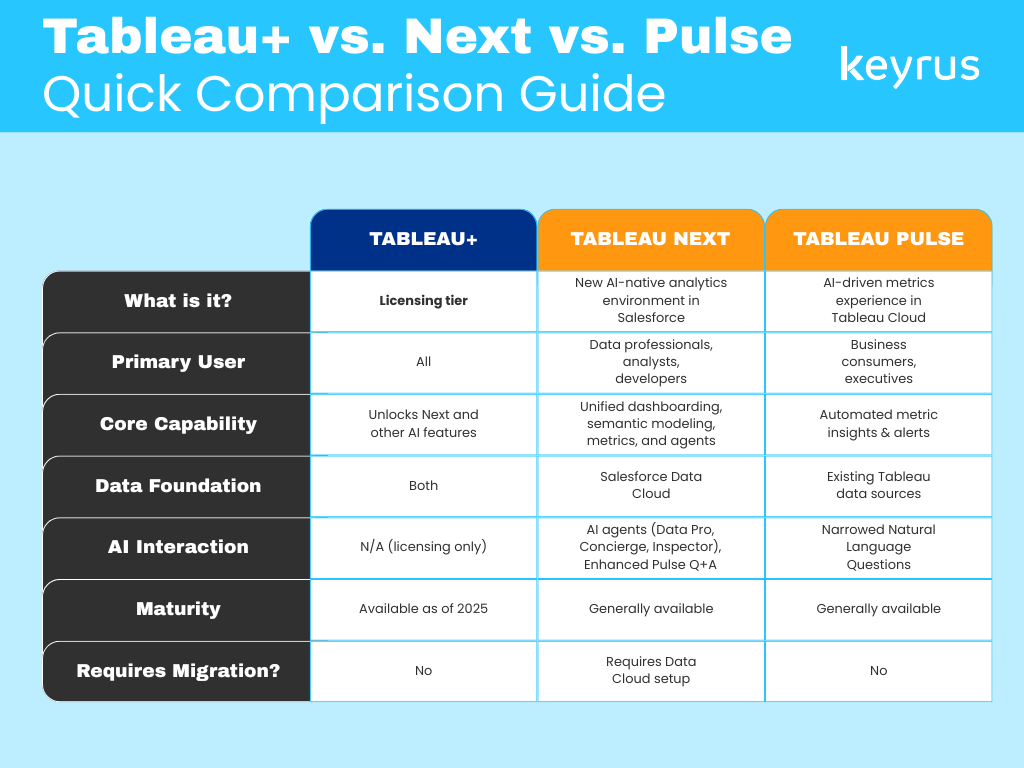
Tableau Pulse is an AI-powered metrics experience included in all Tableau Cloud licensing that surfaces intelligent, personalized insights directly to business consumers. Rather than asking users to navigate a dashboard and draw their own conclusions, Pulse monitors the metrics that matter to a person's role and proactively delivers natural-language explanations of what's happening, why, and what to pay attention to.
Tableau Next is an entirely new, AI-native analytics environment built on Salesforce's Data Cloud and Agentforce platform. Tableau Next unifies what has historically been a fragmented set of tools: traditional dashboarding, semantic modeling, collaboration assets, and agent-driven metrics and insights all live in a single environment. The underlying foundation is Salesforce's Data Cloud and the Agentforce platform, which means Tableau Next is designed from day one to work within the broader Salesforce ecosystem rather than alongside it. It represents a fundamental rethinking of what a modern analytics environment should look like, not just incremental AI features added onto an existing platform, but a ground-up reimagining of how people interact with their data.
Tableau+ is the licensing tier that unlocks access to newer AI-powered capabilities. Unlike Tableau Next and Tableau Pulse, Tableau+ is not a product in its own right; it's a licensing tier that determines what features and capabilities your organization has access to within Tableau Cloud.
In summary, Pulse brings analytics to the business consumer, Next reimagines what an analyst can build and explore, and Tableau+ is the licensing key that unlocks both. The organizations that will get the most out of these investments are the ones that approach them the same way they'd approach any major analytics initiative: with a clear assessment of where they are today, a realistic plan for what needs to be in place before they can adopt each capability, and the right partners and internal champions to see it through.