


Agentic AI is the dominating topic in AI right now. We've moved past the era of asking a chatbot a question and pasting its answer into a document. The newest systems, known as agentic AI, can take a goal, break it into steps, utilize the tools they need, check their own work, and keep going until the job is done. The work gets owned end-to-end by the agent, leading to faster cycle times, fewer manual handoffs, and scaling without adding headcount.
The question for most leaders in 2026 isn't whether to use agentic AI. It's where to use it first, and how to get there without the false starts that stall so many pilots. AI in itself has so many frameworks, from DIY to visual SaaS tools, with Agentic AI falling somewhere in between. The organizations pulling ahead with AI aren't running the most experiments on every department they can think of. Rather, they picked a few high-value workflows, built the data and governance underneath them, and then gave the system room to act. That's the whole playbook, and it's very doable, with the right setup. In this article, we’ll walk through the use cases and possibilities of agentic AI, what it actually is, how a real workflow runs end-to-end, and realistic steps to get started.
Agentic AI Uses & Capabilities
The deployments seeing the best ROI share two traits: high transaction volume and structured, repeatable work. The more standardized the process, the bigger the payoff from an agent. Here are a few areas where agentic AI can already make a real impact:
Customer operations: resolving a customer issue end-to-end, interpreting the request, pulling order and policy context, taking the action (refund, replacement, fix) across systems, and escalating with context only when it hits something outside policy.
Finance: working on an exception to resolution rather than just flagging it. When a payment won't reconcile, or a transaction trips a rule, the system gathers the related records across your ledgers, tests the likely explanations, and either clears it or escalates with the evidence attached, so the close keeps moving, and people see only the genuine edge cases.
Supply chain: responding to a disruption, not just spotting one. When a port closes, or a supplier slips, it works out which orders are exposed, weighs the options (reroute, switch carrier, expedite, re-source), checks each against live cost and capacity, commits to the best, and re-plans when one falls through. The shift is from monitoring to acting.
IT and software: resolving incidents, not just alerting on them. The system investigates across logs, metrics, and recent changes, forms and tests a root-cause hypothesis, applies or proposes a fix, and confirms the issue clears. The same loop drives coding agents that write a change, run the tests, and fix what breaks until it passes.
The common thread is that agentic AI is the most effective for the tasks that quietly consume your team's hours without using their judgment. Gartner predicts that 40% of enterprise applications will include task-specific AI agents by the end of 2026, up from under 5% in 2025. McKinsey finds that while roughly 62% of organizations are experimenting with AI agents, fewer than a quarter have scaled them into production.
AI Agents vs. Agentic AI: What's the Difference?
These two terms get used interchangeably, and that confusion costs real money when teams expect a single-purpose tool to solve a multi-functional problem it was never built for. Here’s the distinction:
An AI agent is a single, task-focused worker. Give it a clear job inside defined boundaries (route this ticket, validate this record, draft this reply), and it does that job, using a language model to reason and tools to act. It's reliable, scoped, and easy to measure. Think of it as one good employee with a clear job description.
Agentic AI is the system around those workers. It's the design pattern where a coordinating layer sets a goal, decides which agents and tools to use, sequences their work, adapts when something changes, and carries a multi-step process from start to finish. If an agent is one employee, agentic AI is the whole department: a manager, several specialists, shared memory of what's happened, and the authority to act across systems.
The simplest way to hold the distinction: an agent executes a task; an agentic system owns an outcome. One waits to be called. The other plans how to reach a goal and pursues it.
Neither is "better." A well-scoped agent is the right call for a regulated, repetitive task where predictability matters most. Agentic AI earns its complexity when the work genuinely spans systems and needs judgment along the way. Most organizations should start with the former and grow into the latter, which is exactly the path we'll map below.
What Makes Up Agentic AI?
Agentic AI isn't one technology. It's a stack of parts that each do a specific job. Here's each one broken down with details about why it matters and where it fits.
The LLM (large language model): An LLM is a model trained on huge amounts of text that can understand language and generate it. This is the technology behind tools like Claude, ChatGPT, and Copilot. In an agentic system, the LLM reads the situation, makes a plan, and decides what to do next. The thing to remember: it has learned patterns, not memorized facts. That makes it a powerful reasoner and an unreliable source of truth on its own. Which is exactly why you don't stop at the model.
RAG (Retrieval Augmented Generation): RAG pairs the language model with a live search over your own content (your policies, your product docs, your records) so its answers are grounded in current, organization-specific information instead of whatever it absorbed in training. The mechanism is simple: before the model answers, the system retrieves the relevant documents and hands them over as context. The consequence is the whole point: the model can only cite what it retrieves, so your answers are only as good as your data and your retrieval design (aka it’s only as good as what you put into it).
Tools and function calling: A model that can only talk is just an expensive chatbot. Tools are the functions and APIs an agent can call to do things: query a database, send an email, update a CRM record, run a calculation. Function calling is how the model decides which tool to use and with what inputs. This is the line between an assistant that suggests and an agent that acts.
MCP (Model Context Protocol): Connecting every model to every tool used to mean writing custom code for each. MCP is an open standard that gives AI applications a consistent way to discover and call external tools and data. The common analogy is a USB-C port for AI: one plug, many devices. MCP turns integration from a custom engineering project into a reusable connection, which is what makes agents practical to build and maintain at scale.
Memory: A stateless model forgets everything between turns. Memory lets an agentic system hold onto what's happened (the steps it has taken, the facts it has gathered, the user's earlier instructions) across a long task or repeated sessions. Short-term memory keeps a single workflow coherent; longer-term memory lets the system improve and personalize over time.
Orchestration: Orchestration is the coordinating logic that ties it all together: it interprets the goal, picks the agents and tools, runs them in the right order, handles failures, and decides when the job is done or when to bring in a human. This is the difference between a pile of capable parts and a system that reliably finishes work, and it's where most of your governance lives. It's the layer that grants and limits what the whole system is allowed to do.
Here's the part most teams get backwards: the model is rarely the bottleneck. What makes or breaks an agentic system is the quality of your data and retrieval, and the orchestration and guardrails that decide what it's allowed to do. The clever model is the easy part; the foundation under it is the actual work.
TL;DR the LLM reasons, RAG grounds, tools act, MCP connects, memory remembers, and orchestration runs the show. Agents are the building blocks; agentic AI is the structure you build with them.
Agentic AI in Action
Here's the same task, two ways. It's an illustrative example that mirrors how these workflows would run in practice.
The single-agent version: an agent monitors shipments and flags the moment one is delayed so a planner can react. Useful, scoped, done.
The agentic version handles the whole disruption, and the path isn't fixed in advance:
A monitoring agent detects that a typhoon has closed a key port and uses the LLM to work out which in-transit orders are affected.
It pulls each order's delivery commitments and contract SLAs with RAG, and flags the shipments that will now miss their dates.
Here's where it stops being a pipeline: instead of following one script, the orchestrator weighs options. A logistics agent prices out the alternatives, rerouting through a different port, switching carriers, air-freighting only the urgent lines, or fulfilling from another warehouse, by calling carrier and ERP systems (tool calls) for cost, capacity, and timing.
It models the trade-offs against each customer's SLA and the cost ceiling, picks the option that protects the most at-risk orders within budget, books it, and updates the affected records, while memory keeps the whole episode straight so nothing is double-booked or missed.
For the orders where no option meets the SLA, it doesn't guess: it escalates to a planner with the ranked options, the cost of each, and a clear recommendation.
What would have been a frantic morning of phone calls and spreadsheets becomes a reasoned response in minutes, with people kept in the loop exactly where judgment matters. The system didn't follow a fixed script; it planned, acted, saw what came back, and adjusted. That's the shape of real agentic value.
How to Start: A 5 Step Guide
The good news is that getting this right is a sequence, not a guessing game. In addition to our roadmap to successful AI deployment, here's the path we guide clients through to get started with AI agents or agentic AI:
1. Pick the workflow, not the technology. Start from a high-value, well-scoped process with real volume and a measurable outcome (a slice of customer ops, an invoice flow, a reconciliation). Resist starting with the most advanced architecture; start with the problem worth solving. As with any data and AI project, we suggest to start small and scaling.
2. Choose the right level of automation. Not every problem needs an agentic system. Match the approach to the work:
3. Build the foundation underneath. Ground the system in clean, current data and solid retrieval, and connect it to the systems it needs (this is where MCP-style connections pay off). Reliable agents are built on reliable data, every time.
4. Set the controls before you scale. Define each agent's scope and permissions, decide where a human approves versus monitors, and turn on logging from day one. These aren't a final step bolted on later; they're what let you expand with confidence.
5. Prove it, then grow. Run the first workflow, measure the outcome, and earn trust. Then extend to adjacent processes and grow from a single grounded agent toward multi-agent orchestration.
Remember: Governance is Key
If autonomy is the value, then it's worth governing. Not because the technology is dangerous, but because good controls are what let you move quickly and be trusted while you do it. Think of it as guardrails that let you drive faster, not brakes that slow you down.
Agentic systems do introduce a few risks that single-model deployments don't, and each maps cleanly to a control:
Cascading errors: one agent's mistake feeds the next. Control it with validation checkpoints between steps and a tight scope per agent.
Scope creep: a goal-seeking system reaches for data or actions you didn't intend. Control it with least-privilege permissions and explicit tool allow-lists.
Accountability gaps: when an autonomous chain produces a bad outcome, you need to reconstruct what happened. Control it with a complete, immutable audit log of every decision and action.
A wider connection surface: every system an agent can reach is one to secure. Control it with the same access discipline you'd apply to any privileged user, plus real-time monitoring.
Limitations and Trade-offs
We won't pretend this is simple, and being transparent about the trade-offs is part of getting the value:
More autonomy means more to oversee: every delegated step is one to monitor and be able to explain.
It's only as good as your data: grounding works when your content is clean and current, and not when it isn't.
Complexity has a cost: don't reach for a multi-agent system when a single grounded agent would do.
Models still make mistakes: guardrails reduce hallucination; human oversight stays essential for consequential calls.
None of this is a reason to wait. It's a reason to be deliberate about where you start, which is the whole point of the roadmap above. But it’s also crucial to be realistic about the limitations and trade-offs with these advancements. Agentic AI is effective and can deliver ROI when strategically utilized and deployed. The keyword here is “strategically”.
The Bottom Line
Agentic AI is a legitimate change in how work gets done. The parts aren't mysterious once you name them: a model to reason, retrieval to ground it, tools to act, a protocol to connect, memory to stay coherent, and orchestration to run the whole thing. The advantage goes to the organizations that treat autonomy as something they earn: pick the right workflow, build the data and governance underneath it, prove the value, and scale from there. If you start grounded and scoped, the path to production-grade agentic AI is well within reach.
How Keyrus Can Help
Most organizations we talk to are somewhere between curiosity and a few stalled pilots. Getting from there to agentic AI that runs reliably in production is the gap we close.
At Keyrus, we help organizations move from experimental AI to industrialized AI, from isolated agents to orchestrated systems, and from insight to execution. This is the discipline we call being an Architect of Intelligence. Designing the Operating System of the intelligent enterprise, where intelligence is embedded into the core of business processes to create sustainable value: we operationalize intelligence. We work alongside your team through every stage, from defining a clear vision to delivering operational value:
-Find the use cases: We help you spot the high-value, well-scoped workflows where agents pay off first and steer you away from the ones that aren't ready.
-Build the foundation: The data quality, retrieval design, and integration that grounded, reliable agents depend on.
-Put the controls in place: Governance mapped, with the audit trails, permissions, and human-in-the-loop checkpoints that agentic systems specifically need.
-Enable your team so your people can supervise, extend, and trust the systems doing the work.
Contact us to talk about where AI can create value in your organization.
An AI agent is a single system built to do one well-defined task within set boundaries. Agentic AI is the broader system that coordinates multiple agents, tools, and data sources to pursue a goal across several steps and systems. An agent executes a task; an agentic system owns an outcome.
In work that's high-volume, rules-heavy, and spread across more than one system — the multi-step processes that quietly eat your team's hours without really needing their judgment. The more repeatable and structured the process, the bigger the payoff. For most organizations the technology is ready enough now that the real question is where to start, not whether.
LLM (Large Language Models) AI models trained on vast quantities of text that can understand and generate human language. The technology behind tools like ChatGPT, Claude, and Microsoft Copilot.
Retrieval Augmented Generation. It connects a language model to a live search over your own content, so answers are grounded in current, organization-specific information rather than the model's general training. It's how you keep an AI from making things up about your business.
An open standard that gives AI applications one consistent way to connect to external tools and data, instead of building custom integrations for every pairing. Now an open-source project under the Linux Foundation, it's often described as a "USB-C port for AI." It's what makes agents practical to connect to many systems at scale.
AWS Bedrock and self-hosted options like n8n offer the strongest data privacy guarantees. Unlike most SaaS tools, AWS Bedrock does not train on your data by default, and self-hosted frameworks keep your data entirely within your own infrastructure. 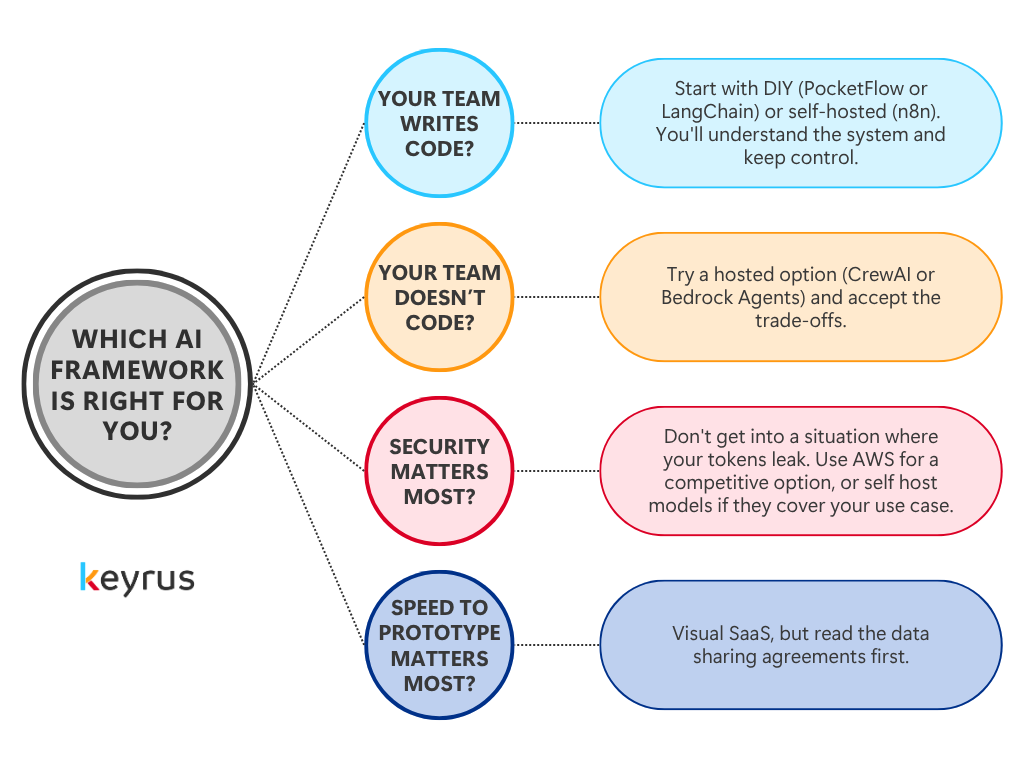
Visual SaaS tools like CrewAI or AWS Bedrock Agents are the best starting point for non-technical teams. They offer no-code or low-code interfaces and fast setup, though teams should review data sharing agreements before committing.
At Keyrus, our perspective is shaped by years of working at the intersection of data strategy and organizational change. We believe AI literacy initiatives are most effective when they: 1. Start with demystification, not technical depth. The goal is confidence and curiosity, not expertise. 2. Connect to real business context. Abstract concepts land when they're illustrated with examples relevant to participants' actual work. 3. Include hands-on engagement. Understanding how a machine learning model learns is more durable when people have trained one, even a simple one. 4. Address ethics and governance alongside capability. These aren't separate topics; they're part of the same conversation. 5. Are tailored by persona. Each level of your organization will have different needs than the others.
At its core, a machine learning model is a mathematical structure that adjusts itself based on data. During training, it's exposed to enormous volumes of examples and iteratively refines its internal parameters to minimize errors. What emerges is not a set of hard-coded rules, but a statistical model of relationships: the AI has learned patterns, not memorized answers.
ML (Machine Learning) A subset of AI where systems learn from data rather than being explicitly programmed. ML models improve with exposure; they find patterns and make predictions without being told the rules.
AI (Artificial Intelligence) The broad field of building machines that can perform tasks requiring human-like intelligence: reasoning, pattern recognition, decision-making, and language understanding.
The term "AI literacy" gets used loosely, so it's worth being precise. AI literacy is the ability to understand, evaluate, and work with artificial intelligence in a way that is effective, purposeful, informed, and responsible. It has three interconnected dimensions: - #1- Conceptual understanding: Knowing what AI is, how it works at a meaningful (if not technical) level, what distinguishes different types of AI systems and how to select the right type of AI tools that would add value to the organization. - #2- Applied capability: Being able to identify where AI can add value in your work, how to interact with AI tools effectively, how to utilize it in a way that brings measurable results, and how to evaluate the outputs you receive. - #3- Ethical and governance awareness: Understanding the risks AI introduces, the biases it can carry, and the responsible practices that should govern its use.
At Keyrus, we believe the three (3) essential practices of AI Governance are model risk management, data quality & governance, and MLOps and continuous monitoring.