


Organizations across every industry are constantly up against the challenge of doing more with less. With AI, teams are able to reduce costs and gain real insights into their customers, operations, and data. But the only way to get the full benefits of AI is with proper AI governance in place. Sounds foreign? Then you're in the right place. Let's dive into everything you need to know and how to get started with AI governance to ensure your organization is getting the full benefits of its tech stack.
A poorly governed AI system doesn't just make mistakes; it makes them at scale, invisibly, and in your organization's name. A model that hallucinates eligibility criteria, misroutes a high-value customer, or leaks PII from a customer record doesn't give you a second chance to correct the record with that stakeholder.
The 3 pillars of AI governance: your framework foundation
Most organizations treat AI governance as an IT project. It isn't. It's an organizational discipline that simultaneously touches data engineering, legal liability, communications standards, and program delivery. At Keyrus, we structure the work around three pillars, and in our experience, a gap in any one of them is sufficient to cause a failure in the other two.
People: The humans who build, use, challenge, and oversee your AI systems, structured around clear roles and a culture of accountability.
Process: The documented rules that govern what your AI can do, what it must refuse, and how its outputs are reviewed, audited, and updated over time.
Technology: The technical stack, including retrieval pipelines, automated guardrails, and data infrastructure, that enforces your policies at runtime.
Pillar 1: Process
Principles don't govern AI; processes do. There's a big difference between stating that your organization "values privacy" and defining, in writing, that no model output may include a customer's name, address, or case ID without explicit retrieval authorization. Your process layer is the formal specification for model behavior: what it can retrieve, what it must refuse, how its outputs are reviewed, and who owns the decision when something goes wrong. Establishing a governance committee is critical for defining accountability processes for GenAI applications. This committee needs to determine how your organization will manage AI. How does your organization manage an AI application and the processes around it? What will happen if someone is interacting with AI and it says something crazy? While the chances of a random hallucination or situation like that happening are low, they are possible. That's why when you're establishing AI processes, human-in-the-loop is a critical component.
Monitor for model drift: Model drift is the gradual degradation of AI accuracy as the real world diverges from the data the model was trained on or grounded on. In practice, this might mean a customer-scoring model that was calibrated during a strong sales year quietly underperforms after a market downturn, without triggering any visible error. Drift reviews should be scheduled at least quarterly, should compare current output distributions against a baseline, and should have a defined threshold that triggers retraining or re-grounding.
Document the full model lifecycle: Every stage, including data sourcing, preprocessing, model selection, fine-tuning, deployment, and eventual decommissioning, needs a documented owner and a retrievable audit trail. Model explainability isn't just a regulatory concept: it's the ability to reconstruct, from logs, why a specific AI output was generated. If a key customer asks why they received a particular email, or a regulator asks how a decision was reached, "AI did it" won't cut it.
Align with frameworks, regulations, and guidelines before you have to: AI regulation varies not only by nation, but also by state in the US. In Europe, the GDPR and EU AI Act are the key regulatory frameworks that organizations must abide by, and if you're a global organization, those regulations must be considered when establishing your governance framework. In the US, the National Institute of Standards and Technology (NIST) introduced the AI Risk Management Framework (AI RMF). This is a voluntary, flexible guide for organizations to manage risks in designing, developing, and deploying AI systems. In Canada, the Artificial Intelligence and Data Act (AIDA) remains influential and focuses on transparency, risk, and accountability. Canada has also announced a similar voluntary AI pact called the Voluntary Code of Conduct on the Responsible Development and Management of Advanced Generative AI Systems. Organizations that sign on to this will voluntarily commit to identified measures for responsible AI use. It's easier to design your systems with these regulations in mind from the start, rather than risk non-compliance and high fees.
Pillar 2: People
When you established your governance committee in the process pillar, you likely had conversations around the people and roles in the committee. Our people pillar somewhat overlaps with the process pillar, but there are distinctions. For people, you must determine and assign roles for your AI governance committee. This AI governance committee will be similar to your data governance committee, if you have one. This committee will need to make decisions on who can see what data, who has access, how you define product and product hierarchy, who handles hallucinations, and who sets security protocols. It's also beneficial to think about what additional skill sets need to be added to your organization. You'll want to go beyond technical skillsets (educational, ethical, etc.). Stewardship is key to this pillar being successful.
What this looks like in practice:
Establish a red team: Designate a small group, typically 3 to 5 people drawn from communications, program, and data teams, tasked with systematically attempting to break your AI before users do. This means probing for jailbreak vulnerabilities, testing whether restricted customer data can be surfaced through indirect prompts, and verifying that guardrail blocks actually fire. Red team findings should feed directly into your model update cycle, not just a report.
Evolve your data roles: The generalist BI analyst profile, who is typically strong in SQL and dashboards but limited in ML and cloud infrastructure, is insufficient for governing a production AI system. Organizations now need to write Python-based data pipelines, configure AWS or Azure cloud environments, and understand prompt engineering well enough to know when a model is behaving unexpectedly. If your organization can't hire for this profile, a consulting partner embedded during deployment is a practical alternative to leaving these gaps unfilled.
Treat AI literacy as a technical control: Staff who understand LLM failure modes are less likely to accept and propagate a confidently wrong output. A two-hour literacy session focused specifically on when not to trust the model is more valuable than a generic "AI awareness" training that your team can click through in 20 minutes. The goal is calibrated skepticism, not enthusiasm or fear.
Pillar 3: Technology
The third pillar of AI governance is technology. More and more technology companies are releasing out-of-the-box capabilities to manage AI hallucinations and alert/guard against misuse. There's even new tech that addresses common AI issues to prevent problems. When establishing your AI governance, it's important to take these technological aspects into consideration. Do you want to have security/preventative tech in addition to your AI?
Retrieval-Augmented Generation (RAG): RAG is the primary technical mechanism for eliminating hallucinations in AI production. Instead of allowing a model to generate answers from its general training data, which has no knowledge of your programs, your policies, or your customers, RAG routes every query through a retrieval step that pulls relevant, verified documents from a controlled source (typically S3 buckets or an internal database) before the model generates a response. The model can only cite what it retrieves. Documents with outdated or incomplete metadata will surface in the wrong context; this is why data hygiene and RAG architecture must be designed together, not sequentially.
Automated guardrails: Guardrails are programmatic rules that intercept a query before the model responds and either block it entirely or route it to a pre-approved static response. Common configurations include blocking any query that requests financial or medical guidance, filtering outputs for PII before delivery, and restricting retrieval to documents tagged for the querying user's role. Amazon Bedrock Guardrails, for example, supports topic denial, PII redaction, and grounding checks as configurable policy layers, meaning your documented policies can be enforced at the infrastructure level rather than relying on the model's own judgment. Practically speaking, guardrails take the form of:
Deterministic filters that scan for credentials, Social Security numbers, or other sensitive data that can be found with simple search patterns. If those filters trap anything, they can either do an on-the-fly replacement or flag the issue for review
LLM-powered guidelines around tone, communication style, and acceptable outputs. They can be configured to modify the output to better suit the proper intent, or again, flag for review.
Targeted language models (small or large) that detect malicious input or output. These typically will simply deny the text from being presented to the user or the LLM.
Data maturity and metadata strategy: The most common reason a well-architected RAG system underperforms is poor document metadata. If your internal documents don't have consistent, accurate date stamps, author attribution, and subject tags, the retrieval layer cannot reliably surface the most current and relevant content. A policy updated six months ago but tagged with a two-year-old date will be ranked below an older version that happens to have better metadata. Data governance work is a prerequisite for RAG quality, not an afterthought.
What Governed AI Can Mean for Your Organization
A solid governance foundation isn't a constraint on ambition; it's what makes ambitious use cases safe to deploy. The following represent applications we have either built for clients or are actively scoping, all of which require the governance infrastructure described above to operate responsibly:
Fast Casual Restaurant Chain, Unifying the Customer View Across Channels: A restaurant chain operating over 200 locations across 15 countries had no single cross-channel view of guest data, no centralized transactional repository, and insufficient data governance. Keyrus built an AWS-hosted architecture combining a data warehouse, a data governance solution to master location data, and BI tooling, resolving 7 million customer records and cutting manual data wrangling by 80%. The lesson: any AI layer built on top of customer data, whether for personalization or churn prediction, needs governed, deduplicated data underneath it, not a patchwork of spreadsheets and disconnected systems.
Global Apparel Manufacturer, Centralizing Business Logic Before Scaling AI: A global apparel and activewear manufacturer had fragmented semantic models and business logic spread across four ERP platforms, making enterprise-wide reporting slow and hard to govern. Keyrus centralized reusable business logic in a modern cloud data foundation, reducing platform spend by more than 40% and cutting data collection and consolidation time from weeks to hours. Governed, consistent business rules are exactly the layer an AI system needs to sit on top of to reason reliably across finance, operations, and inventory data.
Multi-State Education Network, Automating Data Validation at Scale: An organization coordinating data reporting across 224 institutions and 16 member states relied on manual Excel-based processes and expert-maintained SQL databases to manage submissions. Keyrus embedded interactive dashboards directly into the client's existing workflow tools and automated the data validation process, cutting submission time by 50% while migrating 104 spreadsheets into 35 governed dashboards. Automating validation this way is the same discipline that keeps an AI system's inputs trustworthy: garbage in, garbage out applies to models just as much as it applies to reports.
Global Asset Manager, Standardizing Data Onboarding for Growth: A leading alternative asset manager's acquisition strategy was slowed by a data onboarding process that took over a month per new entity, leaving leadership without real-time visibility into newly acquired assets. Keyrus templatized the data mapping process into standardized models and dashboards, cutting onboarding time from a month to a week. The lesson: any organization that wants AI to reason across newly acquired or newly connected data sources needs a repeatable, governed onboarding process, not a one-off manual rebuild each time.
Caution Ahead! AI Risks to Look and Prepare for
Many industries face unique pressures that make AI governance not just important, but vital. Organizations must safeguard public trust, protect the customers and communities they serve, and maintain strict compliance with contractual and regulatory requirements. The organizations that struggle with AI adoption aren't failing because the technology doesn't work. They're failing because they didn't account for what responsible deployment actually requires.
Generative AI introduces three major risk categories that need to be governed:
Bias and Fairness Concerns: Large language models (LLMs) can amplify existing biases, potentially creating discriminatory content in outreach materials or program recommendations. For organizations serving vulnerable populations or highly regulated markets, this isn't just a PR problem; it's an ethical crisis.
Compliance Uncertainty: Organizations operate under a complex web of regulations, from safeguarding requirements for programs serving minors to HIPAA-adjacent rules for health-focused organizations. Without clear governance, audit, and reporting frameworks, AI implementations become compliance landmines.
Data Privacy Risks: When AI models process customer information or sensitive records, any data leakage could violate regulations such as GDPR, state privacy laws, or contractual trust agreements. The consequences aren't just financial; they're reputational disasters that can take years to recover from.
Outside of those general risk categories, don't forget to define your goals. It's great to have a goal of becoming an AI-driven organization, but what does that mean and how does it look? Does implementing a base LLM product fit the criteria you need, or do you want AI to be integrated into every part of your business, with agents running as many administrative tasks as possible? Before any model is built, you need a concrete plan of the requests you expect the system to handle, alongside documented examples of what an acceptable response looks like for each. Without this, there is no way to evaluate whether the model is performing well, no baseline to measure improvement against, and no shared definition of done. Defining your use cases with that level of specificity is tedious work, but it is the single most reliable predictor of a successful deployment.
And with defining goals comes defining expectations. It's important to remember that most LLM applications you currently use are built, deployed, and tuned by massive companies with a vested interest in selling you more LLM usage. There is a lot going on behind the scenes that you won't get as part of the base LLM product. The ease of use you experience is the result of a massively tested and validated product. Your solution won't be at first. Be aware that the first few iterations are rough, but they improve quickly.
What Next? Governance as a Growth Engine
The most successful organizations view AI governance not as a constraint, but as a competitive advantage. When customers, regulators, and partners see comprehensive controls protecting their interests, trust increases. Establishing this trust is crucial to addressing the elephant in the room that pops up in every AI workshop we have conducted. Governed well, AI becomes a structural advantage for your organization, not a one-time initiative.
That distinction matters because in the future, business will run on intelligence, not software. The three pillars in this guide, people, process, and technology, are not a compliance checklist. They are the early architecture of something bigger: an organization where intelligence is not just analyzed, but operated.
This is the thinking behind our Human Orchestrated Model™ (HOM™), the framework we use to architect that operating layer. It is built on three layers that map directly to the governance work described above:
Intelligence Foundations: the governed data, retrieval pipelines, and guardrails that give AI something reliable to reason on.
Human in Command: the roles, committees, and review processes that keep people accountable for what the system does.
Performance Steering: the ongoing measurement and tuning that keeps the system aligned with your goals as conditions change.
Technology amplifies. Culture differentiates. A model is only as trustworthy as the architecture and the people governing it, and that architecture has to be built deliberately, not assembled by accident. Governance frameworks must also reflect each organization's unique mission, values, and stakeholder needs, which is why this work benefits from a partner who has done it before. Keyrus is that architect: we bring the technical possibilities, the governance discipline, and 28 years of data foundations together into one operating system for your organization's intelligence.
AI does not transform businesses. Architected intelligence does.
Learn how Keyrus architects intelligence for your organization.
AI Governance is a set of rules, standards, and policies put in place to ensure AI is being used properly, ethically, legally, and responsibly. It often manages risks such as bias and privacy breaches, while enabling innovation. AI governance ensures that AI technologies are developed, used and maintained in a way that maximizes outcomes and trust while keeping risks and security under control. In short, AI governance maximizes the benefits of your AI investments, whilst minimizing risks and potential harms. Accumulating more than 28 years of experience in data and artificial intelligence, Keyrus helps you to set-up the right AI governance to create competitive advantage from AI.
At Keyrus, we believe the three (3) pillars of AI Governance are Process, People, and Technology. These pillars serve as a solid foundation for building your own AI governance policies and rules.
Establishing a governance committee is critical for defining accountability policies for GenAI applications. This committee needs to determine how your organization will manage AI. How does your organization manage an AI application and the processes around it? What will happen if someone is interacting with AI and it says something crazy? While the chances of a random hallucination or situation like that happening are low, they are possible. That’s why when you’re establishing AI processes, human-in-the-loop is a critical component.
When you established your governance committee in the process pillar, you likely had conversations around the people and roles in the committee. Our people pillar somewhat overlaps with the process pillar, but there are distinctions. For people, you must determine and assign roles for your AI governance committee. This AI governance committee will be similar to your data governance committee if you have one. This committee will need to make decisions on who can see what data, who has access, how you define product and product hierarchy, who handles hallucinations, and who is setting security protocols. It’s also beneficial to think about what additional skill sets need to be added to your organization. You’ll want to go beyond technical skillsets (educational, ethical, etc.). Stewardship is key to this pillar being successful.
The third pillar of AI Governance is Technology. More and more technology companies are releasing out-of-the-box capabilities to manage AI hallucinations and alert/guard against misuse. There’s even new tech that addresses common AI issues to prevent problems. When establishing your AI governance, it’s important to take these technological aspects into consideration. Do you want to have a security/preventative tech in addition to your AI?
At Keyrus, we believe the three (3) essential practices of AI Governance are model risk management, data quality & governance, and MLOps and continuous monitoring.
The term "AI literacy" gets used loosely, so it's worth being precise. AI literacy is the ability to understand, evaluate, and work with artificial intelligence in a way that is effective, purposeful, informed, and responsible. It has three interconnected dimensions: - #1- Conceptual understanding: Knowing what AI is, how it works at a meaningful (if not technical) level, what distinguishes different types of AI systems and how to select the right type of AI tools that would add value to the organization. - #2- Applied capability: Being able to identify where AI can add value in your work, how to interact with AI tools effectively, how to utilize it in a way that brings measurable results, and how to evaluate the outputs you receive. - #3- Ethical and governance awareness: Understanding the risks AI introduces, the biases it can carry, and the responsible practices that should govern its use.
AI (Artificial Intelligence) The broad field of building machines that can perform tasks requiring human-like intelligence: reasoning, pattern recognition, decision-making, and language understanding.
ML (Machine Learning) A subset of AI where systems learn from data rather than being explicitly programmed. ML models improve with exposure; they find patterns and make predictions without being told the rules.
LLM (Large Language Models) AI models trained on vast quantities of text that can understand and generate human language. The technology behind tools like ChatGPT, Claude, and Microsoft Copilot.
At its core, a machine learning model is a mathematical structure that adjusts itself based on data. During training, it's exposed to enormous volumes of examples and iteratively refines its internal parameters to minimize errors. What emerges is not a set of hard-coded rules, but a statistical model of relationships: the AI has learned patterns, not memorized answers.
At Keyrus, our perspective is shaped by years of working at the intersection of data strategy and organizational change. We believe AI literacy initiatives are most effective when they: 1. Start with demystification, not technical depth. The goal is confidence and curiosity, not expertise. 2. Connect to real business context. Abstract concepts land when they're illustrated with examples relevant to participants' actual work. 3. Include hands-on engagement. Understanding how a machine learning model learns is more durable when people have trained one, even a simple one. 4. Address ethics and governance alongside capability. These aren't separate topics; they're part of the same conversation. 5. Are tailored by persona. Each level of your organization will have different needs than the others.
Teams should evaluate four key factors before choosing an AI framework: whether it integrates with their internal data and tools, how it handles security and data access, whether the vendor trains on your data, and whether their team has the technical skills to build and maintain the solution. 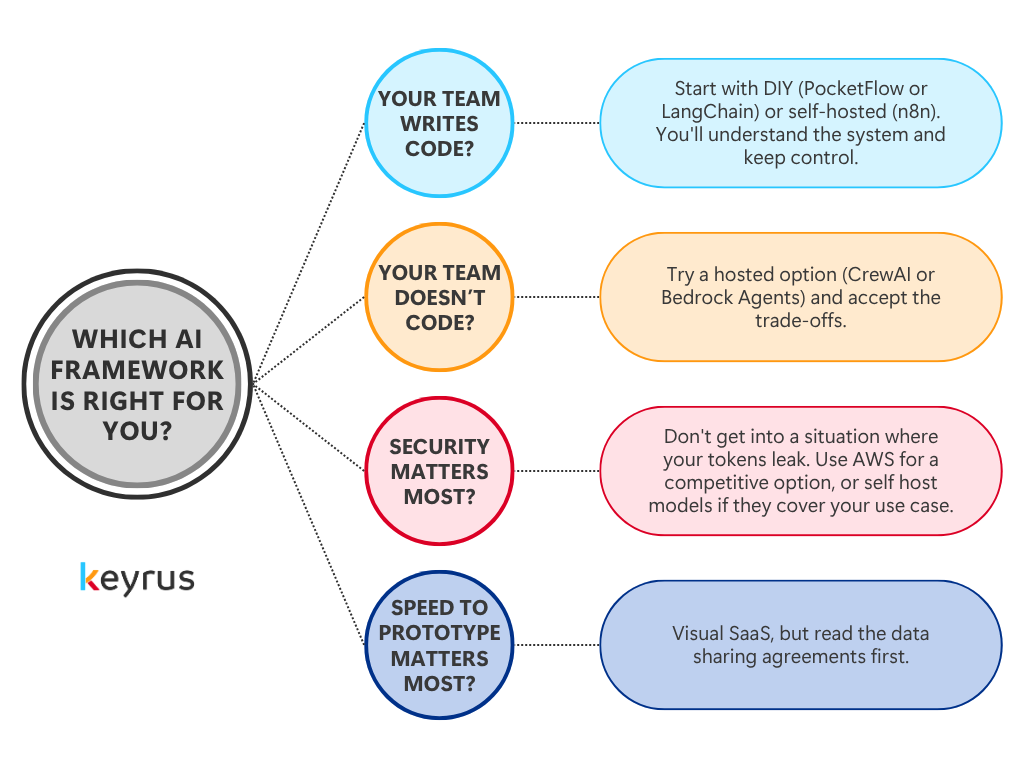
An AI agent is a single system built to do one well-defined task within set boundaries. Agentic AI is the broader system that coordinates multiple agents, tools, and data sources to pursue a goal across several steps and systems. An agent executes a task; an agentic system owns an outcome.