


The AI framework space is a mess. Too many choices, too many promises, and not enough real talk about what actually works when you plug it into your real business. The framework doesn't matter as much as what you feed it. All the fancy orchestration in the world fails if your agent can't touch your actual data or tools.
If you're comparing AI agent frameworks in 2026, you're in the right place. This guide breaks down Visual SaaS, Self-Hosted, DIY, and Agents-as-a-Service options, including LangChain, CrewAI, AWS Bedrock, and n8n, so your team can choose based on security, cost, and technical ability.
The Real Requirements
Before you pick anything, nail these down:
1. Internal data and tool integration. An agent without access to your databases, APIs, and proprietary workflows is just a very expensive chatbot. If the framework can't easily wire into your stack, skip it.
2. Security that doesn't require a prayer. Your agent should have limited access to internal resources. The best practice is simple: give it copies of data, not originals. All destructive actions should be human-reviewed or easily reversible. If the framework treats security as an afterthought, walk away.
3. How much of your agentic context can leak into training data? Most vendors will train on your data, unless you pay them. AWS's Bedrock models (including Claude and Llama) will not, but they might not have your preferred model.
Quick List: Your AI Framework Options
There are more framework options out there than we have blog space or time to cover. But in short, your options can be broken down into these 4 categories:
Visual SaaS Tools
Self-Hosted
Agents as a Service
DIY
Each of these options has pros, cons, and key considerations that will most definitely affect your team. We’ll give you our high-level overview, options within each category, and a verdict of what choosing each category means for you and your business.
Visual SaaS Tools: Fast, But at a Cost
These make building agents feel like playing with Legos. No code, drag-and-drop flows, live in minutes. The catch? Most rely on outside vendors who will train on your data. Your incoming and outgoing data becomes part of their model improvement pipeline.
- OpenAI Agent Kit: Requires an enterprise subscription to get real privacy guarantees. Good if you have budget and trust OpenAI's promises.
- CrewAI: The popular pick right now. Seems solid, but it's young and untested at scale. You're basically a beta tester.
Verdict: Fast to start, but you're trading speed for data risk.
Self-Hosted: More Work, More Control
- n8n: The OG of workflow tools that works surprisingly well with LLMs. Data teams love it because it visually represents node flows intuitively. It's not free for enterprise (SSO, shared projects cost), but for smaller teams or startups, it's solid. You own your data, you own the infrastructure. Be prepared to write some connectors and custom tooling, though.
- Firecrawl Open Agent Builder: Open source, but it's opinionated. You're locked into Firecrawl for search and web scraping, which some might say defeats the purpose of "self-hosted."
Verdict: More setup, but you keep the keys to the kingdom.
Agents as a Service: Let Someone Else Deal With It
AWS Bedrock Agents: Cheap (you pay for LLM tokens, that's it). Scales to sizes you'll never need. Access to Bedrock's full range of models. The downside? Programming it is painful. You're fighting the abstraction layer if you need custom tool orchestration or modified LLM calls. And the builder? It's the console if you're a masochist, or VSCode if you can sling Terraform.
Verdict: Good for standard, rigidly defined workflows, takes time for anything complex. If you're already on AWS, it might be good enough, though.
DIY: The Ends of the Spectrum
A real Wild West kind of situation going on, so this list is by no means comprehensive, but let's take a look at the 2 ends of the spectrum:
Maximum complexity: LangChain
Brings everything together. Integrates seamlessly with LangSmith (their debugging tool), their model catalog, and hosted models. You get full control and power.
Cost: Requires solid programming skills and time. You're building, not configuring.
Minimum viable: PocketFlow (the 100-line agent)
Bring your own models, tools, and databases. Write a few lines of Python and chain any agentic pattern you want. You learn how agents actually work.
Cost: You're coding, so your team better like writing code.
Verdict: DIY wins if you understand your problem and have the bandwidth. You avoid vendor lock-in and bloat.
The Decision Tree
With all these options, it’s easiest to consider what is most applicable and important to your business to help decide on a framework.
- Your team writes code? Start with DIY (PocketFlow or LangChain) or self-hosted (n8n). You'll understand the system and keep control.
- Your team doesn't code? Try a hosted option (CrewAI or Bedrock Agents) and accept the trade-offs.
- Security is non-negotiable? Don't get into a situation where your tokens leak. Use AWS for a competitive option, or self-host models if they cover your use case.
- Speed to first prototype matters most? Visual SaaS, but read the data sharing agreements first.
The Real Conclusion
There are too many choices because the problem isn't solved yet. We're still figuring out how agents should work.
What is solved: integration with your internal systems is the make-or-break factor. A perfectly orchestrated agent that doesn't know who you are, what you do, nor can do anything for you is useless.
At Keyrus, we guide organizations through every stage of AI and data maturity from defining a clear vision to delivering operational value. Are you ready to make your data matter? Contact us to get started.
Visual SaaS tools like CrewAI or AWS Bedrock Agents are the best starting point for non-technical teams. They offer no-code or low-code interfaces and fast setup, though teams should review data sharing agreements before committing.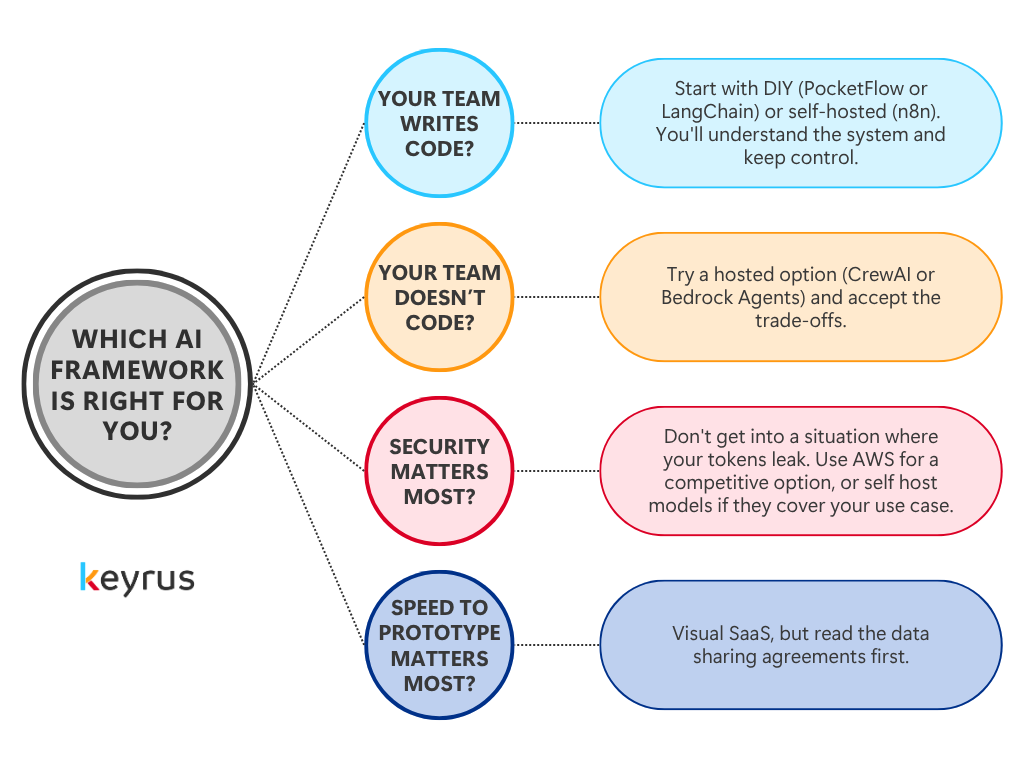
AWS Bedrock and self-hosted options like n8n offer the strongest data privacy guarantees. Unlike most SaaS tools, AWS Bedrock does not train on your data by default, and self-hosted frameworks keep your data entirely within your own infrastructure. 
LangChain is a developer-focused DIY framework offering maximum control and deep integration with tools like LangSmith, but requires strong programming skills. CrewAI is a visual, low-code platform that is faster to set up but is newer, less battle-tested at scale, and carries data privacy trade-offs.
Teams should evaluate four key factors before choosing an AI framework: whether it integrates with their internal data and tools, how it handles security and data access, whether the vendor trains on your data, and whether their team has the technical skills to build and maintain the solution. 
AWS Bedrock is a cost-effective, highly scalable option for AI agents, as you only pay for LLM tokens used. It is best suited for standard, well-defined workflows. Custom tool orchestration can be complex, and the developer experience requires familiarity with AWS tooling like Terraform or the AWS console.
n8n is a self-hosted workflow automation tool that works well with large language models. It is a strong choice for teams that want full data ownership, a visual node-based interface, and flexibility — without relying on outside vendors. Enterprise features like SSO come at a cost, but smaller teams can use it for free.
PocketFlow is a lightweight, minimal Python framework for building AI agents in roughly 100 lines of code. It is best for technical teams who want to understand how agents work at a foundational level, avoid vendor lock-in, and bring their own models, tools, and databases.
AI (Artificial Intelligence) The broad field of building machines that can perform tasks requiring human-like intelligence: reasoning, pattern recognition, decision-making, and language understanding.
ML (Machine Learning) A subset of AI where systems learn from data rather than being explicitly programmed. ML models improve with exposure; they find patterns and make predictions without being told the rules.
LLM (Large Language Models) AI models trained on vast quantities of text that can understand and generate human language. The technology behind tools like ChatGPT, Claude, and Microsoft Copilot.
At its core, a machine learning model is a mathematical structure that adjusts itself based on data. During training, it's exposed to enormous volumes of examples and iteratively refines its internal parameters to minimize errors. What emerges is not a set of hard-coded rules, but a statistical model of relationships: the AI has learned patterns, not memorized answers.
AI Governance is a set of rules, standards, and policies put in place to ensure AI is being used properly, ethically, legally, and responsibly. It often manages risks such as bias and privacy breaches, while enabling innovation. AI governance ensures that AI technologies are developed, used and maintained in a way that maximizes outcomes and trust while keeping risks and security under control. In short, AI governance maximizes the benefits of your AI investments, whilst minimizing risks and potential harms. Accumulating more than 28 years of experience in data and artificial intelligence, Keyrus helps you to set-up the right AI governance to create competitive advantage from AI.
At Keyrus, we believe the three (3) pillars of AI Governance are Process, People, and Technology. These pillars serve as a solid foundation for building your own AI governance policies and rules.