


AWS Summit came to Toronto earlier this month, and, like most headlines right now, the focus was on AI. But not on the ideation of what AI can do for businesses; rather, it focused on the shift from general cloud adoption to practical AI execution. AWS positioned agentic AI as a major focus area, but what stood out was how much of the messaging was tied to real industry workflows rather than generic AI demos.
Overall, there was a clear message from AWS Summit in Toronto: AWS is moving the conversation from cloud infrastructure to industry-specific AI outcomes.
The keynote reinforced the broader architecture behind this shift: open data architecture, search, semantic layers, vector capabilities, streaming, analytics, governance, and scalable cloud infrastructure. Amazon OpenSearch Serverless was positioned as a search and vector engine designed for agents, while AWS also emphasized open data architecture across analytics, databases, AI/ML, search, and streams on top of Amazon S3.
Some of the strongest examples came from the expo floor and sessions, and we'll walk through those here:
Healthcare
AWS showcased agentic AI supporting clinical documentation and coding. The demo showed an assistant drafting clinical notes, suggesting ICD-10/CPT codes, and providing reasoning for the provider to review and approve. The key message was human-in-the-loop AI that reduces administrative burden while maintaining oversight.
Education
There was a grant discovery and proposal development use case focused on research institutions. The solution supported researcher profiles, grant matching, grant search, knowledge base access, and proposal generation. This was a good example of AI helping users navigate large volumes of institutional and external information.
Manufacturing
The shop floor optimization use case was one of the strongest demonstrations. It showed how agentic AI can help operators diagnose production issues using IoT sensor data, equipment measurements, SOPs, manuals, knowledge bases, and natural language interfaces. This connects well to our manufacturing conversations we often have with our clients around operational efficiency, knowledge capture, and reducing downtime.
Banking & Financial Services
AWS also emphasized cloud economics and measurable business value in financial services, including improved onboarding, faster product launches, reduced underwriting decision time, and lower regulatory reporting costs. There was also a secure enterprise AI search example focused on regulated environments and governed access to internal knowledge.
Retail
A session on AI agents for loss prevention showed how event-driven architecture, custom ML models, deterministic rules, and foundation models can help surface risky transactions and patterns for human review.
Keyrus & AWS
As an Advanced Tier Services partner, we help organizations operationalize AI in the AWS ecosystem. At Keyrus, we help organizations move from experimental AI to industrialized AI, from isolated agents to orchestrated systems, and from insight to execution. This is the discipline we call being an Architect of Intelligence. Designing the Operating System of the intelligent enterprise, where intelligence is embedded into the core of business processes to create sustainable value: we operationalize intelligence. Learn more about our partnership or contact us to start your AWS ecosystem.
AWS Bedrock is a cost-effective, highly scalable option for AI agents, as you only pay for LLM tokens used. It is best suited for standard, well-defined workflows. Custom tool orchestration can be complex, and the developer experience requires familiarity with AWS tooling like Terraform or the AWS console.
AWS Bedrock and self-hosted options like n8n offer the strongest data privacy guarantees. Unlike most SaaS tools, AWS Bedrock does not train on your data by default, and self-hosted frameworks keep your data entirely within your own infrastructure. 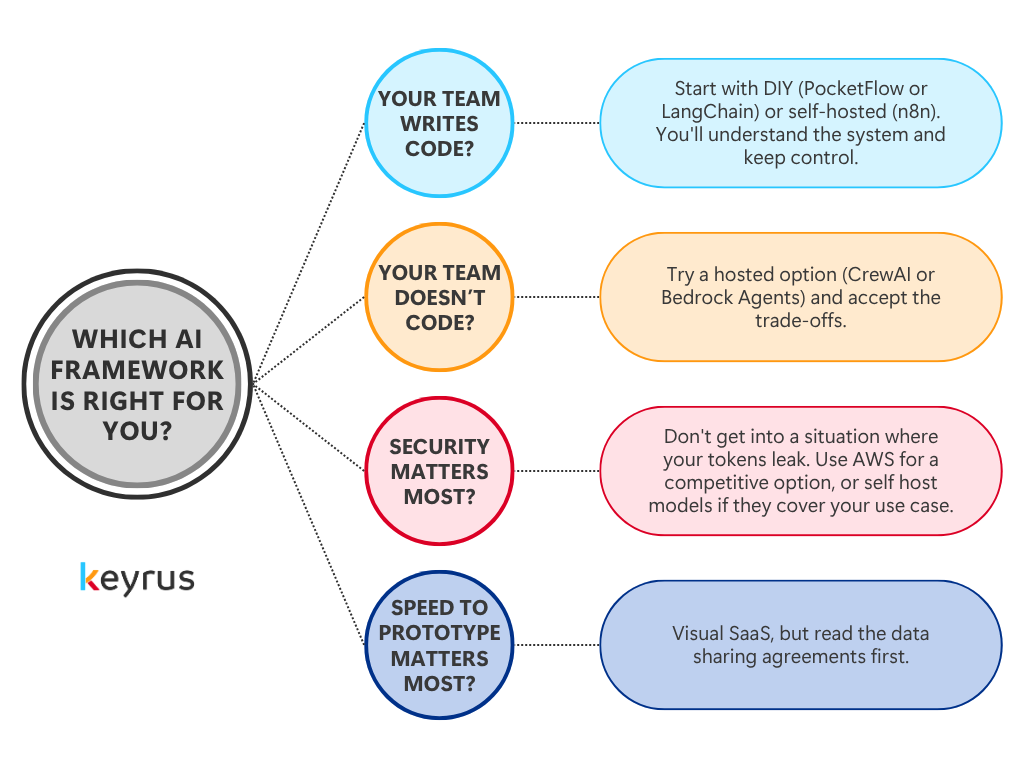
Visual SaaS tools like CrewAI or AWS Bedrock Agents are the best starting point for non-technical teams. They offer no-code or low-code interfaces and fast setup, though teams should review data sharing agreements before committing.
AI Governance is a set of rules, standards, and policies put in place to ensure AI is being used properly, ethically, legally, and responsibly. It often manages risks such as bias and privacy breaches, while enabling innovation. AI governance ensures that AI technologies are developed, used and maintained in a way that maximizes outcomes and trust while keeping risks and security under control. In short, AI governance maximizes the benefits of your AI investments, whilst minimizing risks and potential harms. Accumulating more than 28 years of experience in data and artificial intelligence, Keyrus helps you to set-up the right AI governance to create competitive advantage from AI.
The term "AI literacy" gets used loosely, so it's worth being precise. AI literacy is the ability to understand, evaluate, and work with artificial intelligence in a way that is effective, purposeful, informed, and responsible. It has three interconnected dimensions: - #1- Conceptual understanding: Knowing what AI is, how it works at a meaningful (if not technical) level, what distinguishes different types of AI systems and how to select the right type of AI tools that would add value to the organization. - #2- Applied capability: Being able to identify where AI can add value in your work, how to interact with AI tools effectively, how to utilize it in a way that brings measurable results, and how to evaluate the outputs you receive. - #3- Ethical and governance awareness: Understanding the risks AI introduces, the biases it can carry, and the responsible practices that should govern its use.
Agentic AI takes initiative it plans, executes, and adapts autonomously unlike traditional AI, which only reacts to user prompts.
At Keyrus, we believe the three (3) pillars of AI Governance are Process, People, and Technology. These pillars serve as a solid foundation for building your own AI governance policies and rules.